Is MongoDB a Relational Database? MongoDB vs SQL Databases Explained
Is MongoDB a relational database? Learn how MongoDB differs from relational databases, how NoSQL compares with SQL, and when to choose MongoDB, MySQL, or PostgreSQL.
Is MongoDB a Relational Database? MongoDB vs SQL Databases Explained
Is MongoDB a relational database? No. MongoDB is a NoSQL document database, not a traditional relational database.
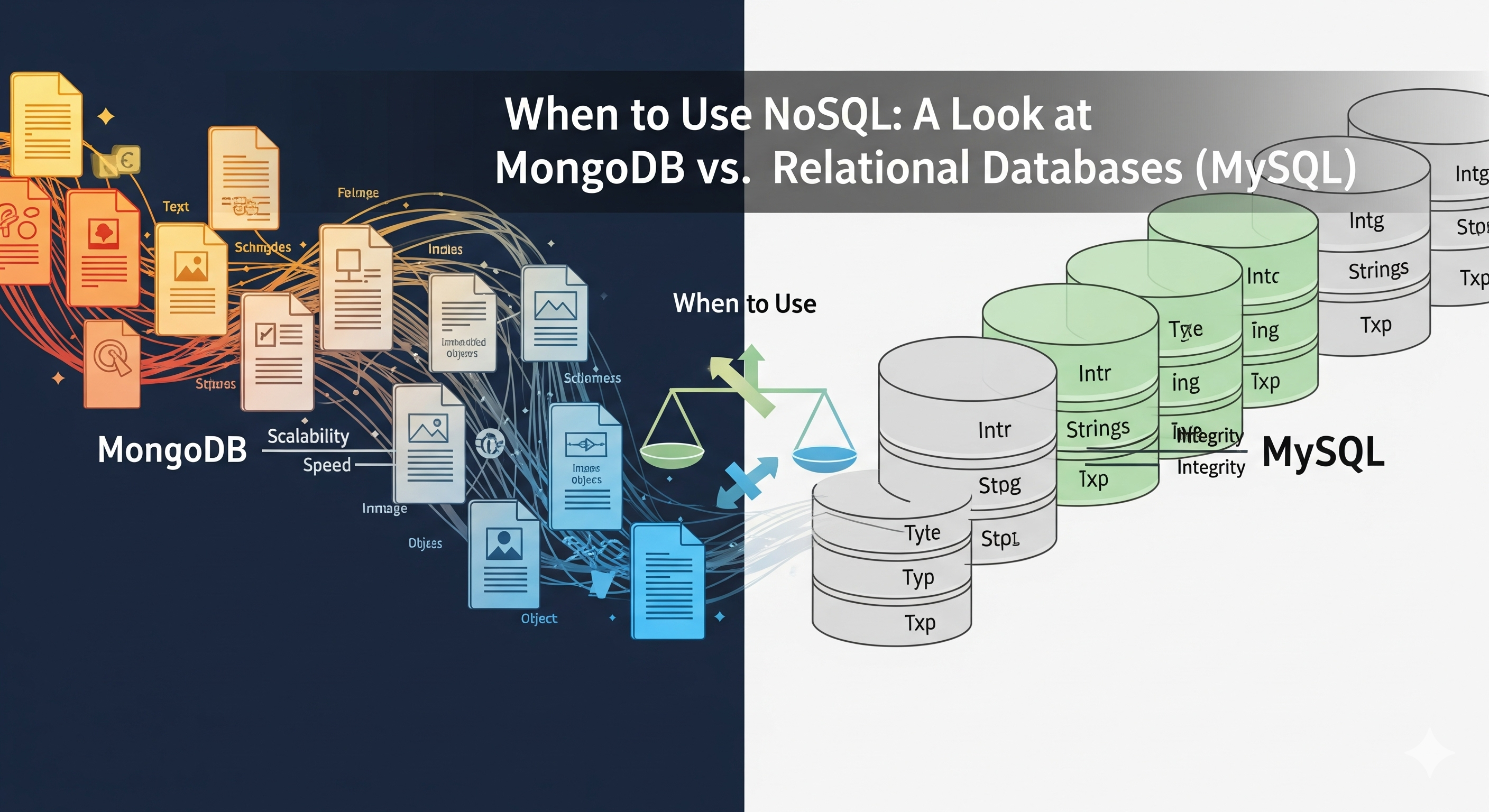
MongoDB stores data as flexible, JSON-like documents inside collections, while relational databases such as PostgreSQL and MySQL organize data primarily into tables, rows, and columns.
That does not mean MongoDB cannot handle relationships or transactions. MongoDB supports references between documents and multi-document transactions, while its document model provides a different way of designing and accessing data.
This guide explains the differences between MongoDB and relational databases, how SQL and NoSQL databases approach data modeling, and when each type of database makes sense for a real application.
Quick Answer: Is MongoDB a Relational Database?
No. MongoDB is a NoSQL database.
MongoDB is a document-oriented database that stores records as BSON documents inside collections. Its flexible document model allows related information to be embedded together when that fits the application's access patterns.
A traditional relational database stores data in structured tables made up of rows and columns. Relationships between tables are commonly represented using primary keys and foreign keys.
In simple terms:
| MongoDB | Relational Database |
|---|---|
| NoSQL document database | SQL relational database |
| Collections | Tables |
| Documents | Rows |
| Fields | Columns |
| Embedded documents | Related tables |
| References | Foreign keys |
| MongoDB Query API | SQL |
| Flexible document structure | Structured schema |
The important distinction is the data model. MongoDB and relational databases can both solve many of the same application problems, but they organize and access data differently.
What Is MongoDB?
MongoDB is a NoSQL document database designed around storing data as documents.
Instead of splitting an application's data into many tables, a MongoDB document can contain nested objects and arrays.
For example, a user document could contain an embedded address:
{
  "name": "John",
  "email": "[email protected]",
  "address": {
    "city": "Washington",
    "country": "US"
  }
}
The exact structure depends on the application's requirements and how the data will be queried.
MongoDB uses BSON, a binary representation of JSON-like documents, internally. This makes the document model particularly convenient for applications built with JavaScript and Node.js.
What Is a Relational Database?
A relational database organizes data into tables containing rows and columns.
For example, a relational database might store users and addresses in separate tables:
users
--------------------------------
id | name   | email
1  | John  | [email protected]


addresses
--------------------------------
id | user_id | city
1  | 1       | Washington
The user_id can be used to associate the address with the corresponding user.
Relational databases commonly use SQL, or Structured Query Language, to insert, retrieve, update, and analyze data.
Popular relational databases include:
- PostgreSQL
- MySQL
- MariaDB
- Microsoft SQL Server
- Oracle Database
MongoDB vs Relational Databases
The biggest difference between MongoDB and a relational database is how data is modeled.
Documents vs Rows
MongoDB stores information in documents:
{
  "name": "John",
  "skills": ["React", "Node.js", "MongoDB"]
}
A relational database would normally represent this information using rows and columns, potentially with additional tables when a user has multiple skills.
MongoDB's document model can make application data easier to represent when related information is naturally accessed together.
Collections vs Tables
MongoDB groups documents into collections.
Relational databases group rows into tables.
For example:
MongoDB:
users
  ├── document
  ├── document
  └── document
Compared with:
SQL:
users
  ├── row
  ├── row
  └── row
The concepts are similar at a high level, but their underlying data models are different.
Flexible Schema vs Structured Schema
MongoDB provides a flexible document model. Documents in the same collection can have different fields when the application requires it.
For example:
{
  "name": "Alice",
  "email": "[email protected]"
}
and:
{
  "name": "Bob",
  "email": "[email protected]",
  "company": "Example Inc"
}
can exist in the same collection.
Relational databases generally use a defined table schema with columns and data types.
However, flexible schema does not mean MongoDB applications should have no structure. MongoDB also supports schema validation, and well-designed applications should still enforce appropriate data rules.
Does MongoDB Have Relationships?
Yes.
Calling MongoDB a NoSQL database does not mean that it cannot represent relationships.
MongoDB applications can model relationships using:
- Embedded documents
- Arrays
- References
- Application-level lookups
- Aggregation operations
For example, a user document could contain embedded profile information when that information is normally retrieved together.
Alternatively, a separate document can be referenced when the related data is large, shared, or independently managed.
Embedding vs Referencing
A useful rule is:
Embed data when it is commonly read together and has a reasonable size and lifecycle.
Reference data when it is shared, independently updated, or can grow without a predictable bound.
For example, an address may be a reasonable candidate for embedding inside a user document.
A large collection of orders is generally better modeled separately rather than embedding an ever-growing array inside a user document.
The right choice depends on the application's access patterns.
Is MongoDB SQL or NoSQL?
MongoDB is NoSQL, not a traditional SQL relational database.
MongoDB does not use SQL as its primary query language. Instead, applications use MongoDB's query and aggregation APIs to work with documents.
The terms can be summarized as:
MongoDB → NoSQL → Document Database

PostgreSQL → SQL → Relational Database
MySQL      → SQL → Relational Database
This distinction is useful, but it does not mean that NoSQL databases are simply "better" or "worse" than SQL databases. They are designed around different data models and application requirements.
MongoDB vs MySQL
MongoDB and MySQL are both widely used application databases, but they approach data differently.
| Feature | MongoDB | MySQL |
|---|---|---|
| Database type | NoSQL document database | Relational database |
| Data model | Documents | Tables |
| Query approach | MongoDB Query API | SQL |
| Schema | Flexible | Structured |
| Relationships | Embedding and references | Foreign keys and joins |
| Transactions | Supported | Supported |
| Scaling | Includes horizontal sharding | Multiple scaling strategies |
| Best fit | Document-oriented applications | Structured relational workloads |
Neither database is automatically the right choice for every application.
MongoDB vs PostgreSQL
PostgreSQL is another popular relational database and is particularly capable for applications requiring complex SQL queries, relationships, constraints, and transactional workloads.
MongoDB can be attractive when the application's data naturally maps to documents and when flexible document structures are useful.
PostgreSQL can be attractive when the application relies heavily on relational modeling, complex joins, constraints, and SQL-based analytical queries.
The decision should be based on the application's data model and workload rather than popularity alone.
Transactions and Consistency
A common misconception is that MongoDB cannot perform transactions.
MongoDB supports multi-document transactions, allowing operations across multiple documents to be committed or rolled back together.
Relational databases also provide mature transaction systems and are widely used for workloads where transactional integrity is central to the application.
For example, financial operations such as transferring money between accounts require careful transactional design regardless of the database technology.
The important question is not simply whether a database supports transactions, but whether its transaction and consistency model fits the application's requirements.
Querying, Indexing, and Performance
Both MongoDB and relational databases support indexes.
Indexes can significantly improve queries that frequently search, sort, or filter by particular fields, but they also consume storage and can increase the cost of writes.
MongoDB provides an aggregation framework for pipeline-based data processing.
Relational databases use SQL and provide powerful capabilities for joins, grouping, window functions, filtering, and analytical queries.
There is no universal performance winner.
A database that performs well for one workload may perform poorly for another. The application's actual read patterns, write patterns, indexes, dataset size, query complexity, and infrastructure all matter.
For production systems, benchmark realistic workloads instead of choosing a database based only on theoretical performance claims.
Scaling MongoDB and Relational Databases
MongoDB supports horizontal scaling through sharding, allowing data to be distributed across multiple servers.
Relational databases can also scale using a variety of strategies, including:
- Vertical scaling
- Read replicas
- Partitioning
- Clustering
- Sharding in systems that support it
- Caching and application-level architecture
Therefore, it is too simplistic to say that MongoDB scales horizontally while SQL databases only scale vertically.
The appropriate scaling strategy depends on the specific database, workload, infrastructure, and consistency requirements.
When Should You Use MongoDB?
MongoDB can be a good fit when:
- Your data is naturally document-oriented.
- Your documents contain nested structures or arrays.
- Your application's schema is expected to evolve.
- Related information is commonly retrieved together.
- You need MongoDB's sharding and distributed database capabilities.
- Your development stack works naturally with JSON-like data.
- Your application handles content, catalogs, events, or other document-oriented data.
Examples include:
- Content platforms
- Product catalogs
- Activity feeds
- Event and telemetry systems
- Some real-time applications
- Rapidly evolving applications
These are examples, not strict rules. MongoDB can be used for many other workloads when its data model and operational characteristics fit the requirements.
When Should You Use a Relational Database?
A relational database can be a good fit when:
- Data has strong relationships between entities.
- Foreign keys and constraints are important.
- Complex joins are common.
- The application depends heavily on SQL.
- Strong transactional guarantees are central to the workload.
- Structured reporting and analytical queries are important.
Examples include:
- Banking systems
- Payment processing
- Accounting systems
- ERP applications
- Complex inventory systems
- Applications with highly relational business data
Again, these are guidelines rather than absolute rules.
Can MongoDB Replace MySQL or PostgreSQL?
Sometimes, but not automatically.
MongoDB and relational databases can both serve as the primary database for many web applications. Whether MongoDB can replace MySQL or PostgreSQL depends on the application's data model, queries, transaction requirements, reporting needs, operational requirements, and existing architecture.
If an application relies heavily on relational constraints and complex SQL joins, migrating to MongoDB may require substantial data-model changes.
On the other hand, an application built around document-oriented data may benefit from MongoDB's model.
The database should be selected based on the workload rather than forcing the workload to fit a preferred database.
Common MongoDB Misconceptions
"MongoDB is a relational database"
No. MongoDB is a NoSQL document database.
"MongoDB cannot handle relationships"
It can. Relationships can be represented using embedded documents, arrays, references, and aggregation operations.
"MongoDB cannot perform transactions"
MongoDB supports multi-document transactions.
"NoSQL means there is no schema"
Not necessarily. MongoDB provides a flexible document model, but applications can enforce structure through application validation and MongoDB's schema validation features.
"SQL databases cannot scale horizontally"
This is also too broad. Relational databases have multiple scaling strategies, and some relational systems support horizontal distribution.
MongoDB vs SQL: Quick Decision Guide
Use this as a starting point rather than a strict rule:
-
Is your data naturally document-shaped?
MongoDB may be a good fit. -
Do you rely heavily on complex joins and relational constraints?
A relational database may be a better fit. -
Does your schema evolve frequently?
MongoDB's flexible document model may be useful. -
Are complex multi-entity transactions central to your application?
Evaluate relational databases and MongoDB's transaction capabilities against your specific requirements. -
Do you need extensive SQL-based reporting and analytical queries?
A relational database may be a natural choice. -
Do you need distributed scaling for very large document-oriented workloads?
MongoDB's sharding capabilities may be useful.
MongoDB and Relational Databases Can Coexist
Choosing MongoDB does not mean an application can never use a relational database.
Some architectures use polyglot persistence, where different databases are selected for different workloads.
For example:
Application
    │
    ├── MongoDB
    │     └── Flexible document-oriented data
    │
    └── PostgreSQL
          └── Transactional relational data
This approach can be useful when different parts of an application have genuinely different data requirements.
However, operating multiple database systems also introduces additional infrastructure, monitoring, backup, development, and operational complexity.
MongoDB and SQL Tooling
Some commonly used tools include:
MongoDB
- MongoDB Atlas — managed MongoDB hosting
- MongoDB Compass — graphical interface for MongoDB
- Mongoose — ODM commonly used with Node.js applications
Relational Databases
- PostgreSQL
- MySQL
- MariaDB
- Prisma
- TypeORM
The choice of tooling should follow the database and application architecture rather than the other way around.
Best Practices for Choosing a Database
Before choosing MongoDB or a relational database:
- Understand the application's data relationships.
- Identify the most important read and write patterns.
- Define transaction and consistency requirements.
- Consider expected data volume and growth.
- Design appropriate indexes.
- Consider reporting and analytical requirements.
- Evaluate operational and backup requirements.
- Benchmark realistic workloads when performance is important.
- Consider the team's experience with the database.
- Avoid choosing a database purely because it is popular.
Final Thoughts
MongoDB is not a relational database. It is a NoSQL document database.
The difference is primarily in how data is modeled and accessed.
MongoDB's document model can work particularly well for flexible, nested, document-oriented data. Relational databases such as PostgreSQL and MySQL remain strong choices for structured data, complex relationships, SQL-heavy workloads, and applications where relational constraints are central.
There is no universally best database.
The right choice depends on your application's data model, queries, transactions, scalability requirements, consistency needs, and operational constraints.
If you are building a MERN application, MongoDB can be a natural choice, but understanding relational databases is equally valuable because many real-world systems use SQL databases or combine multiple database technologies.
Found this helpful?
Follow me for more development insights and tutorials